The question of sequence cadence design — how many touches, which channels, how far apart, and when to stop — has generated a persistent mythology in the SDR world. You've seen the posts: "We analyzed 10,000 sequences and found that touch 7 is where most deals are won." The problem with most of that content is that it pools data across prospecting and reactivation sequences, across different ICPs, across different ACV tiers, and presents aggregate patterns as universal prescriptions. The reality is that optimal cadence design for lead reactivation is meaningfully different from optimal cadence for cold outbound — and treating them as the same produces predictably poor results.
This article focuses specifically on reactivation sequences: outreach to contacts who previously engaged with your marketing or sales team, went dormant for a defined period, and are being re-approached based on new intent signals or a systematic reactivation motion. The data patterns for this population are distinct, and the cadence recommendations that follow are grounded in what those patterns show.
Why Reactivation Cadence Differs From Outbound Cadence
Cold outbound sequences are starting a relationship from zero. The contact has no prior association with your brand, no prior engagement context, and — depending on your prospecting quality — may or may not be in your ICP. Outbound sequences need to establish context, build familiarity, and justify why the prospect should allocate attention to you. This is why longer outbound cadences (8 to 12 touches over 30+ days) show incremental response rate gains at later touchpoints — you're working against initial unfamiliarity.
Reactivation sequences are a fundamentally different situation. The contact has prior brand familiarity. They engaged with your content, your sales team, or your product at some point and didn't disengage because they hated what they saw — they disengaged because timing, budget, priority, or internal dynamics were wrong. A reactivation sequence that looks identical to a cold outbound sequence ignores this prior relationship and undersells the contextual advantage you have. It also risks annoying a contact who already knows your brand by presenting as if the prior relationship didn't exist.
The cadence implication: reactivation sequences can be shorter and still achieve comparable or better response rates than outbound, because the contact already has the brand awareness that outbound sequences spend the first 4 to 5 touches building. The engagement that does happen tends to be more substantive — when a dormant contact responds to a reactivation touch, they're more likely to engage with actual evaluation questions, not just "thanks, we'll keep you in mind."
What the Engagement Data Shows
Across reactivation sequence data from B2B SaaS companies with moderate-to-high ACV products (average contract values in the $15,000 to $60,000 annual range), several consistent patterns emerge. These are descriptive of what tends to happen, not prescriptive of what must happen for your specific ICP — treat them as calibration points, not benchmarks to hit.
Touch count distribution: the majority of positive responses in reactivation sequences — typically 55 to 65 percent — occur at touches 1 through 3. Touch 4 and 5 capture an additional 20 to 25 percent. Touches 6 and beyond produce diminishing returns, with response rates on later touches sometimes statistically indistinguishable from baseline. This pattern is more pronounced for reactivation than for cold outbound, where later-touch response rates are a larger share of total. The practical implication: a 5-touch reactivation sequence captures most of the available response. Extending to 8 or 9 touches adds marginal incremental response at the cost of increased unsubscribe risk and deliverability impact from disengaged contacts.
Spacing: the first 3 touches in a reactivation sequence perform best with a moderate pace — day 1, day 4, day 8 (roughly 3 to 4 day gaps) — rather than the more compressed 1-2-3 day cadence that some outbound playbooks recommend. Compressed cadences work for high-urgency cold outbound (short consideration cycles, transactional products) but feel more aggressive to a contact who already knows your brand. A reactivation touch that comes one day after the previous one can register as pushy rather than persistent, which is a different experience than the same cadence on a net-new cold contact.
Touches 4 and 5 should have wider spacing — day 14 and day 21 — to allow time for intent signals to develop between attempts. If the contact has returned to your website between touches 3 and 4, that changes what touch 4 should say. If they haven't engaged with anything, touch 4 can take a lower-pressure angle (a relevant piece of content, a question about whether their situation has changed) rather than another explicit ask for a meeting.
Channel Mix: Email Is Not Enough for Reactivation
Single-channel email sequences dramatically underperform multi-channel sequences for reactivation, and the gap is larger than for cold outbound. The reason is contextual: a dormant contact has already been through your email nurture stream and didn't respond. More emails from the same domain — even well-written, contextually personalized ones — face a higher baseline skepticism than a first contact from that domain would. Breaking the pattern with a channel change is disproportionately effective.
LinkedIn touches at touch 2 or touch 3 — either a connection request with a brief note or an InMail — consistently lift reactivation response rates. The mechanism is plausibly the channel novelty and the signal of intentionality: a person who sought out the contact's LinkedIn profile and sent a personalized note is communicating a higher level of interest than another email in an already-active inbox.
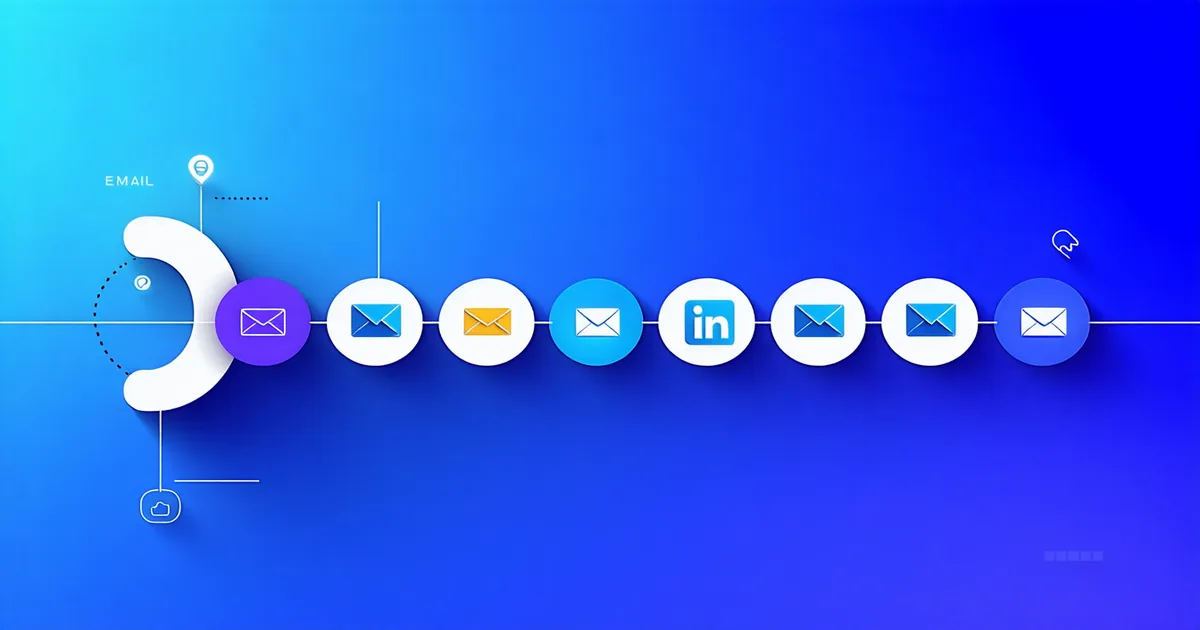
The effective multi-channel pattern for reactivation sequences: touch 1 — email (personalized, references prior engagement, acknowledges time elapsed); touch 2 — LinkedIn connection or InMail (3 to 4 days later, brief and direct); touch 3 — email follow-up referencing the LinkedIn outreach; touch 4 — email with a different angle (new content, new product update, case study relevant to their vertical); touch 5 — final "break up" email that closes the loop explicitly and gives the contact a low-friction way to re-engage when their timing is right ("if Q3 isn't the right time, happy to reconnect in Q4 — just let me know").
For higher-ACV segments where it's appropriate, adding a phone call at touch 2 or touch 3 in place of or alongside the LinkedIn touch shows meaningful lift in connect rates. Cold calling a dormant lead is a different experience than cold calling a genuinely unknown prospect — the contact has context on who you are, which changes the tone of the conversation significantly.
The Personalization-Automation Trade-off
The most common objection to sequence automation for reactivation is the fear that automated sequences feel impersonal and damage brand perception. This is a real concern, but it conflates two separate problems: bad personalization and automation. A well-configured automated sequence in Outreach or Salesloft, using dynamic fields populated with real enrichment data and contextual reference to the contact's prior engagement history, does not read as generic. A poorly configured sequence that uses "Hi {{first_name}}, I wanted to reach out" and nothing else is the problem — and that same sequence would be just as bad if a human typed it manually.
The practical personalization variables that have measurable impact on reactivation reply rates: referencing the specific content or channel that originally generated the contact's engagement (not just their company or role), acknowledging a firmographic change that's occurred since the prior engagement (company growth, product launch, market shift in their industry), and using a subject line that is specific rather than generic. "Quick question about your RevOps stack at [Company]" outperforms "Following up" by a margin that compounds across the volume of a large reactivation sequence run.
We're not saying full personalization at scale is easy — it requires clean data, reliable enrichment pipelines, and careful template design. We're saying that the returns on getting it right are large enough to justify the investment, particularly for high-ACV reactivation targets where even a modest lift in reply rate translates to meaningful pipeline contribution.
A/B Testing Cadence Variables: What to Test and What to Ignore
Sequence cadence A/B testing produces useful signal when the test is isolated and the sample size is sufficient, and produces noise when neither condition is met. The variables worth testing, in order of likely impact: email subject line (the highest-impact variable for open rate); touch 1 message body — specifically whether to lead with context acknowledgment ("It's been a while since we connected...") versus a forward-looking angle that doesn't reference the dormancy; and sequence length (4-touch versus 6-touch on the same base population, controlling for other variables). Variables not worth testing until you have 500+ contacts per arm: send time optimization, day-of-week effects, signature format. These second-order effects are real but small and require large sample sizes to detect reliably.
Run tests in Outreach or Salesloft using their native A/B sequence variant features, with explicit arm assignment rather than random enrollment — random enrollment in a small reactivation cohort can create imbalanced arms in ways that confound results. Measure at the reply rate level and the positive-response rate level (not just the open rate level), with a minimum 3-week measurement window before drawing conclusions. Carry winning variants forward and retire losing ones, but don't over-iterate — changing cadence variables every two weeks prevents you from accumulating the sample size needed for confident conclusions.